En dat is de makkelijke. Karmijn zit wereldwijd in snoep, yoghurt en frisdrank, en heet op een etiket ook cochineal, E120 of natural red 4. Zebugs leest de ingrediëntenlijst in zestien talen, waar je ook scant, zodat jij dat niet hoeft.
Een app van RayCroc Digital
De app is nog niet uit
Zebugs wordt gebouwd en is nog niet in de Google Play Store te vinden. Deze pagina staat er alvast, zodat te controleren valt wie erachter zit en wat de app met je gegevens doet.
Scan de barcodeInsecten gevonden, en welkeNiets gevonden
Waar Zebugs naar zoekt
Vier insectensoorten die nu voor voedsel gekweekt worden, en twee middelen van dierlijke oorsprong die er al veel langer in zaten. Alle zes duiken op etiketten over de hele wereld op.
HuiskrekelAcheta domesticus
MeelwormTenebrio molitor
BuffalowormAlphitobius diaperinus
TreksprinkhaanLocusta migratoria
Karmijn (E120)Cochenilleluis (Dactylopius coccus)
Schellak (E904)Lakschildluis (Kerria lacca)
Wat Zebugs doet
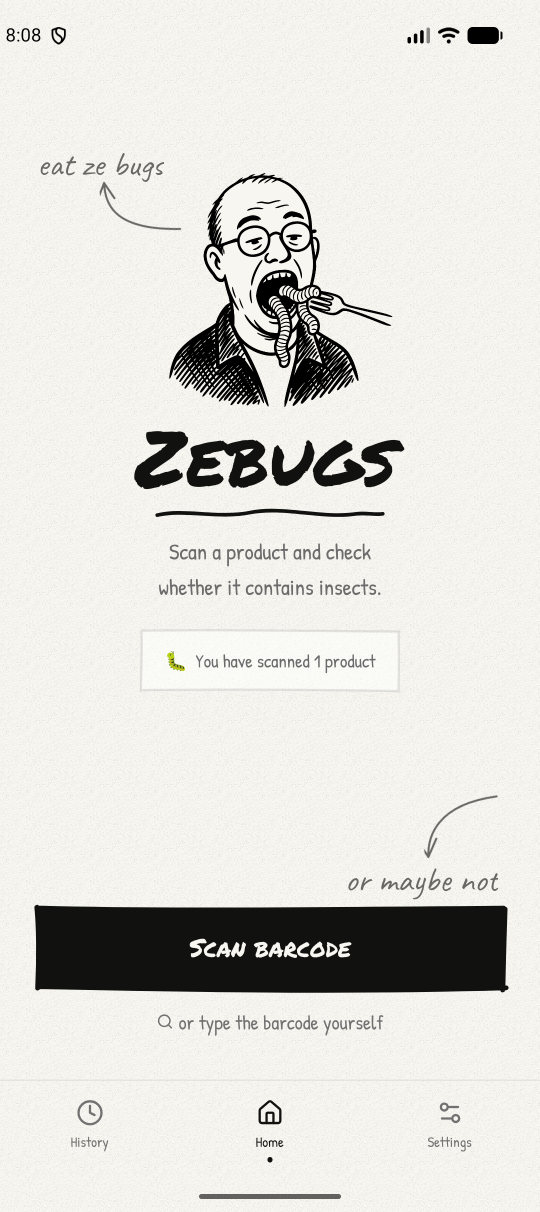
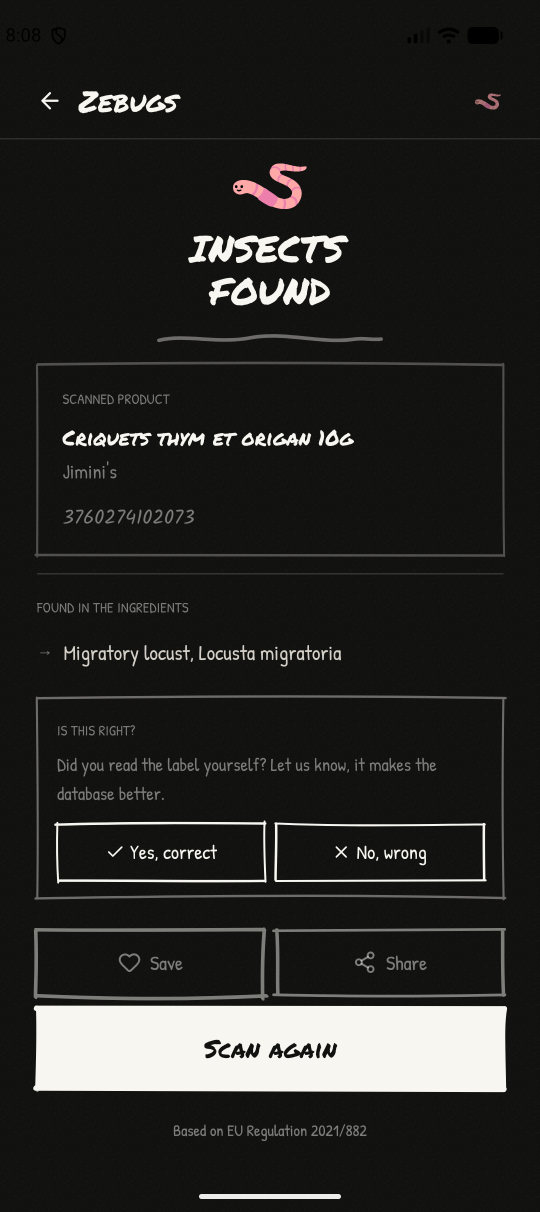
Zebugs scant de barcode of leest de ingrediëntenlijst, en zegt of er insecten in zitten. Dit is wat we checken.
Waar we op checken
Vier bekende insectensoorten die voor voedsel gekweekt worden: meelworm, buffaloworm, huiskrekel en treksprinkhaan. Plus twee middelen die uit insecten gemaakt worden: karmijn (E120) en schellak (E904). We herkennen ze in zestien talen, onder hun Latijnse naam en onder namen als cochineal, natural red 4 en confectioner’s glaze.
Waar het antwoord vandaan komt
Eerst onze eigen lijst met handmatig nagekeken producten, daarna Open Food Facts en tot slot wat gebruikers hebben ingestuurd. Elke keer lezen we de ingrediëntenlijst opnieuw. Daardoor wordt de herkenning steeds beter en het antwoord ook.
Als we het product niet kennen
Als we het niet zeker weten, zeggen we dat. Scan de ingrediëntenlijst zelf, dat gebeurt op jouw toestel. Of stuur foto’s in, dan voegen wij het product toe voor iedereen na jou.
Waar Zebugs werkt
Overal. Karmijn en schellak zitten in snoep, frisdrank, yoghurt en de glans op fruit, op elk continent. En een barcode is overal gewoon een barcode.
Wat we niet checken
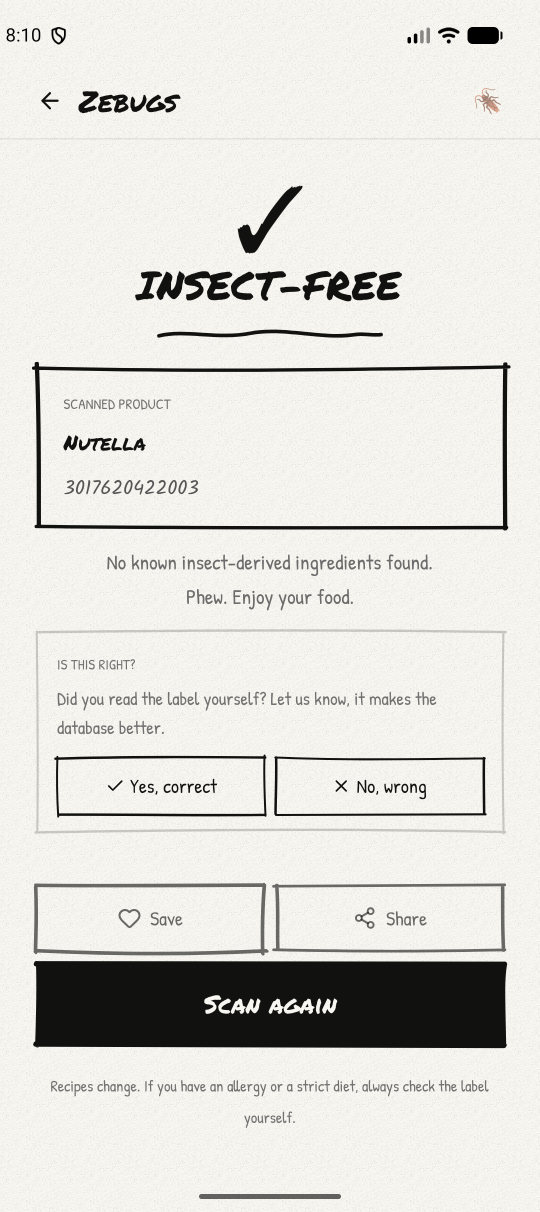
Recepturen veranderen, soms zonder dat de verpakking meeverandert. We zeggen alleen iets over insecten, niet over gelatine, alcohol of allergenen. Bij een allergie of een streng dieet is het etiket de bron, wij zijn het hulpmiddel. Controleer altijd zelf het etiket voor de zekerheid.
Wat er op je toestel blijft
Je scangeschiedenis staat op je telefoon; alleen je eigen back-up bij Google of Apple neemt hem mee. Camerabeelden bewaren we niet, behalve de foto’s die je zelf instuurt. De details staan in het privacybeleid.
58producten die iemand met de hand heeft nagekeken
And that is the easy one. Carmine is in sweets, yoghurt and soft drinks worldwide, and on a label it also reads cochineal, E120 or natural red 4. Zebugs reads the ingredient list in sixteen languages, wherever you scan, so you do not have to.
An app by RayCroc Digital
The app is not out yet
Zebugs is being built and is not in the Google Play Store yet. This page is here already so that who stands behind it, and what the app does with your data, can be checked.
Scan the barcodeInsects found, and whichNothing found
What Zebugs looks for
Four insect species now farmed for food, and two agents of animal origin that have been in it for far longer. All six turn up on labels anywhere in the world.
House cricketAcheta domesticus
Yellow mealwormTenebrio molitor
Lesser mealwormAlphitobius diaperinus
Migratory locustLocusta migratoria
Carmine (E120)Cochineal (Dactylopius coccus)
Shellac (E904)Lac insect (Kerria lacca)
What Zebugs does
Zebugs scans the barcode or reads the ingredient list, and tells you whether there are insects in it. This is what we check.
What we check for
Four well-known insect species farmed for food: yellow mealworm, lesser mealworm, house cricket and migratory locust. Plus two agents made from insects: carmine (E120) and shellac (E904). We recognise them in sixteen languages, under their Latin names and under names like cochineal, natural red 4 and confectioner’s glaze.
Where the answer comes from
First our own list of manually checked products, then Open Food Facts, and finally what users have sent in. Every time, we read the ingredient list again. That is how the recognition keeps getting better, and the answer with it.
If we do not know the product
If we are not sure, we say so. Scan the ingredient list yourself, that happens on your phone. Or send in photos, and we add the product for everyone after you.
Where Zebugs works
Everywhere. Carmine and shellac are in sweets, soft drinks, yoghurt and the shine on fruit, on every continent. And a barcode is simply a barcode anywhere.
What we do not check
Recipes change, sometimes without the packaging changing with them. We only say something about insects, not about gelatine, alcohol or allergens. If you have an allergy or a strict diet, the label is the source, we are the tool. Always check the label yourself to be sure.
What stays on your phone
Your scan history is on your phone; only your own backup at Google or Apple takes it along. We keep no camera images, apart from the photos you send in yourself. The details are in the privacy policy.
Y ese es el caso fácil. El carmín está en caramelos, yogures y refrescos de todo el mundo, y en una etiqueta también se lee cochineal, E120 o natural red 4. Zebugs lee la lista de ingredientes en dieciséis idiomas, escanees donde escanees, para que tú no tengas que hacerlo.
Una aplicación de RayCroc Digital
La aplicación todavía no ha salido
Zebugs se está construyendo y aún no está en la Google Play Store. Esta página ya está aquí para que se pueda comprobar quién hay detrás y qué hace la aplicación con tus datos.
Escanea el códigoInsectos encontrados, y cuálesNo se ha encontrado nada
Qué busca Zebugs
Cuatro especies de insecto que ahora se crían para alimentación, y dos agentes de origen animal que llevan ahí mucho más tiempo. Los seis aparecen en etiquetas de todo el mundo.
Grillo domésticoAcheta domesticus
Gusano de la harinaTenebrio molitor
Escarabajo del estiércolAlphitobius diaperinus
Langosta migratoriaLocusta migratoria
Carmín (E120)Cochinilla (Dactylopius coccus)
Goma laca (E904)Insecto de la laca (Kerria lacca)
Qué hace Zebugs
Zebugs escanea el código de barras o lee la lista de ingredientes, y te dice si lleva insectos. Esto es lo que comprobamos.
Qué comprobamos
Cuatro especies de insecto conocidas que se crían para alimentación: gusano de la harina, escarabajo del estiércol, grillo doméstico y langosta migratoria. Más dos agentes hechos con insectos: carmín (E120) y goma laca (E904). Los reconocemos en dieciséis idiomas, bajo su nombre latino y bajo nombres como cochineal, natural red 4 y confectioner’s glaze.
De dónde sale la respuesta
Primero nuestra propia lista de productos revisados a mano, después Open Food Facts y por último lo que han enviado los usuarios. Cada vez leemos la lista de ingredientes de nuevo. Así el reconocimiento mejora cada vez más, y la respuesta también.
Si no conocemos el producto
Si no estamos seguros, lo decimos. Escanea la lista de ingredientes tú mismo, eso ocurre en tu teléfono. O envía fotos, y añadimos el producto para todos los que vengan después de ti.
Dónde funciona Zebugs
En todas partes. El carmín y la goma laca están en caramelos, refrescos, yogur y el brillo de la fruta, en todos los continentes. Y un código de barras es simplemente un código de barras en cualquier sitio.
Lo que no comprobamos
Las recetas cambian, a veces sin que cambie el envase. Solo decimos algo sobre insectos, no sobre gelatina, alcohol o alérgenos. Si tienes una alergia o una dieta estricta, la etiqueta es la fuente, nosotros la herramienta. Comprueba siempre la etiqueta tú mismo para estar seguro.
Qué se queda en tu teléfono
Tu historial de escaneos está en tu teléfono; solo tu propia copia de seguridad en Google o Apple se lo lleva. No guardamos imágenes de la cámara, salvo las fotos que envías tú mismo. Los detalles están en la política de privacidad.
58productos que alguien ha comprobado a mano
16idiomas que la aplicación sabe leer en una etiqueta
Yaourt maigre, fraises 8%, sucre, amidon, colorant : carmin (E120), épaississant : farine de graines de caroube (E410).
c’est de la cochenille broyée
Et c’est le cas facile. Le carmin est dans les bonbons, les yaourts et les sodas partout dans le monde, et sur une étiquette il s’écrit aussi cochineal, E120 ou natural red 4. Zebugs lit la liste des ingrédients en seize langues, où que vous scanniez, à votre place.
Une application de RayCroc Digital
L’application n’est pas encore sortie
Zebugs est en cours de développement et n’est pas encore disponible sur le Google Play Store. Cette page existe déjà pour que l’on puisse vérifier qui se trouve derrière et ce que l’application fait de vos données.
Scannez le code-barresDes insectes, et lesquelsRien trouvé
Ce que Zebugs cherche
Quatre espèces d’insectes désormais élevées pour l’alimentation, et deux agents d’origine animale présents depuis bien plus longtemps. Les six se retrouvent sur des étiquettes partout dans le monde.
Grillon domestiqueAcheta domesticus
Ver de farineTenebrio molitor
Petit ténébrion matAlphitobius diaperinus
Criquet migrateurLocusta migratoria
Carmin (E120)Cochenille (Dactylopius coccus)
Gomme-laque (E904)Cochenille laque (Kerria lacca)
Ce que fait Zebugs
Zebugs scanne le code-barres ou lit la liste d’ingrédients, et vous dit s’il y a des insectes dedans. Voici ce que nous vérifions.
Ce que nous cherchons
Quatre espèces d’insectes connues, élevées pour l’alimentation : ver de farine, petit ténébrion mat, grillon domestique et criquet migrateur. Plus deux agents issus d’insectes : le carmin (E120) et la gomme-laque (E904). Nous les reconnaissons en seize langues, sous leur nom latin et sous des noms comme cochineal, natural red 4 et confectioner’s glaze.
D’où vient la réponse
D’abord notre propre liste de produits vérifiés à la main, ensuite Open Food Facts, et enfin ce que les utilisateurs ont envoyé. À chaque fois, nous relisons la liste d’ingrédients. C’est ainsi que la reconnaissance s’améliore sans cesse, et la réponse avec elle.
Si nous ne connaissons pas le produit
Si nous ne sommes pas sûrs, nous le disons. Scannez la liste d’ingrédients vous-même, cela se passe sur votre téléphone. Ou envoyez des photos, et nous ajoutons le produit pour tous ceux qui viendront après vous.
Où Zebugs fonctionne
Partout. Le carmin et la gomme-laque sont dans les bonbons, les sodas, les yaourts et le brillant des fruits, sur tous les continents. Et un code-barres est tout simplement un code-barres partout.
Ce que nous ne vérifions pas
Les recettes changent, parfois sans que l’emballage change avec elles. Nous ne parlons que des insectes, pas de la gélatine, de l’alcool ni des allergènes. En cas d’allergie ou de régime strict, l’étiquette est la source, nous sommes l’outil. Vérifiez toujours l’étiquette vous-même pour être sûr.
Ce qui reste sur votre téléphone
Votre historique de scans est sur votre téléphone ; seule votre propre sauvegarde chez Google ou Apple l’emporte. Nous ne conservons aucune image de la caméra, hormis les photos que vous envoyez vous-même. Les détails sont dans la politique de confidentialité.
58produits vérifiés à la main par quelqu’un
16langues que l’application sait lire sur une étiquette
Und das ist der einfache Fall. Karmin steckt weltweit in Süßigkeiten, Joghurt und Limonade, und auf dem Etikett heißt es auch cochineal, E120 oder natural red 4. Zebugs liest die Zutatenliste in sechzehn Sprachen, wo du auch scannst, damit du es nicht musst.
Eine App von RayCroc Digital
Die App ist noch nicht draußen
Zebugs wird gerade gebaut und ist noch nicht im Google Play Store. Diese Seite steht schon hier, damit nachprüfbar ist, wer dahintersteht und was die App mit deinen Daten macht.
Barcode scannenInsekten gefunden, und welcheNichts gefunden
Wonach Zebugs sucht
Vier Insektenarten, die inzwischen für Lebensmittel gezüchtet werden, und zwei Mittel tierischen Ursprungs, die schon viel länger drin sind. Alle sechs tauchen auf Etiketten überall auf der Welt auf.
Zebugs scannt den Barcode oder liest die Zutatenliste und sagt dir, ob Insekten drin sind. Das prüfen wir.
Worauf wir prüfen
Vier bekannte Insektenarten, die für Lebensmittel gezüchtet werden: Mehlwurm, Getreideschimmelkäfer, Heimchen und Wanderheuschrecke. Dazu zwei Mittel aus Insekten: Karmin (E120) und Schellack (E904). Wir erkennen sie in sechzehn Sprachen, unter ihrem lateinischen Namen und unter Namen wie cochineal, natural red 4 und confectioner’s glaze.
Woher die Antwort kommt
Zuerst unsere eigene Liste von Hand geprüfter Produkte, danach Open Food Facts und zuletzt, was Nutzer eingeschickt haben. Jedes Mal lesen wir die Zutatenliste neu. Dadurch wird die Erkennung immer besser, und die Antwort auch.
Wenn wir das Produkt nicht kennen
Wenn wir nicht sicher sind, sagen wir das. Scanne die Zutatenliste selbst, das passiert auf deinem Handy. Oder schick Fotos ein, dann fügen wir das Produkt für alle nach dir hinzu.
Wo Zebugs funktioniert
Überall. Karmin und Schellack stecken in Süßigkeiten, Limonade, Joghurt und im Glanz auf Obst, auf jedem Kontinent. Und ein Barcode ist überall einfach ein Barcode.
Was wir nicht prüfen
Rezepturen ändern sich, manchmal ohne dass die Verpackung mitgeht. Wir sagen nur etwas über Insekten, nichts über Gelatine, Alkohol oder Allergene. Bei einer Allergie oder strenger Ernährung ist das Etikett die Quelle, wir sind das Werkzeug. Prüfe zur Sicherheit immer selbst das Etikett.
Was auf deinem Handy bleibt
Dein Scan-Verlauf liegt auf deinem Handy; nur deine eigene Sicherung bei Google oder Apple nimmt ihn mit. Kamerabilder speichern wir nicht, außer den Fotos, die du selbst einschickst. Die Details stehen in der Datenschutzerklärung.
58Produkte, die jemand von Hand geprüft hat
16Sprachen, die die App auf einem Etikett lesen kann
وهذه هي الحالة السهلة. الكارمين موجود في الحلوى والزبادي والمشروبات الغازية حول العالم، وعلى الملصق يُكتب أيضًا cochineal أو E120 أو natural red 4. Zebugs يقرأ قائمة المكونات بستّ عشرة لغة، أينما مسحت، حتى لا تضطر أنت.
تطبيق من RayCroc Digital
التطبيق لم يصدر بعد
Zebugs قيد البناء وليس بعد في متجر Google Play. هذه الصفحة موجودة من الآن حتى يمكن التحقق من هوية من يقف خلفه ومما يفعله التطبيق ببياناتك.
امسح الباركودعُثر على حشرات، وأيّهالم يُعثر على شيء
عمّا يبحث Zebugs
أربعة أنواع من الحشرات تُربّى اليوم للغذاء، ومادتان من أصل حيواني موجودتان فيه منذ وقت أطول بكثير. والستة جميعها تظهر على ملصقات في كل أنحاء العالم.
صرصور الغيط المنزليAcheta domesticus
دودة الدقيقTenebrio molitor
دودة البوفالوAlphitobius diaperinus
الجراد المهاجرLocusta migratoria
الكارمين (E120)حشرة القرمز (Dactylopius coccus)
الشيلاك (E904)حشرة اللك (Kerria lacca)
ماذا يفعل Zebugs
Zebugs يمسح الباركود أو يقرأ قائمة المكونات، ويخبرك إن كانت فيها حشرات. هذا ما نفحصه.
ما الذي نبحث عنه
أربعة أنواع معروفة من الحشرات تُربّى للغذاء: دودة الدقيق، ودودة البوفالو، وصرصور الغيط المنزلي، والجراد المهاجر. ومادتان مصنوعتان من الحشرات: الكارمين (E120) والشيلاك (E904). نتعرف عليها بستّ عشرة لغة، تحت اسمها اللاتيني وتحت أسماء مثل cochineal وnatural red 4 وconfectioner’s glaze.
من أين يأتي الجواب
أولًا قائمتنا الخاصة بالمنتجات المُراجعة يدويًا، ثم Open Food Facts، وأخيرًا ما أرسله المستخدمون. في كل مرة نقرأ قائمة المكونات من جديد. وهكذا يتحسّن التعرف باستمرار، ويتحسّن الجواب معه.
إذا كنا لا نعرف المنتج
إن لم نكن متأكدين، نقول ذلك. امسح قائمة المكونات بنفسك، فذلك يحدث على هاتفك. أو أرسل صورًا، فنضيف المنتج لكل من يأتي بعدك.
أين يعمل Zebugs
في كل مكان. الكارمين والشيلاك موجودان في الحلوى والمشروبات الغازية والزبادي ولمعان الفاكهة، في كل قارة. والباركود ببساطة باركود في أي مكان.
ما لا نفحصه
الوصفات تتغير، أحيانًا دون أن تتغير العبوة معها. نحن لا نقول شيئًا إلا عن الحشرات، لا عن الجيلاتين أو الكحول أو مسببات الحساسية. إذا كان لديك حساسية أو نظام غذائي صارم، فالملصق هو المصدر ونحن الأداة. تحقّق دائمًا من الملصق بنفسك للاطمئنان.
ما الذي يبقى على هاتفك
سجل المسح على هاتفك؛ لا يأخذه معه إلا نسختك الاحتياطية لدى غوغل أو آبل. لا نحفظ صور الكاميرا، عدا الصور التي ترسلها بنفسك. التفاصيل في سياسة الخصوصية.